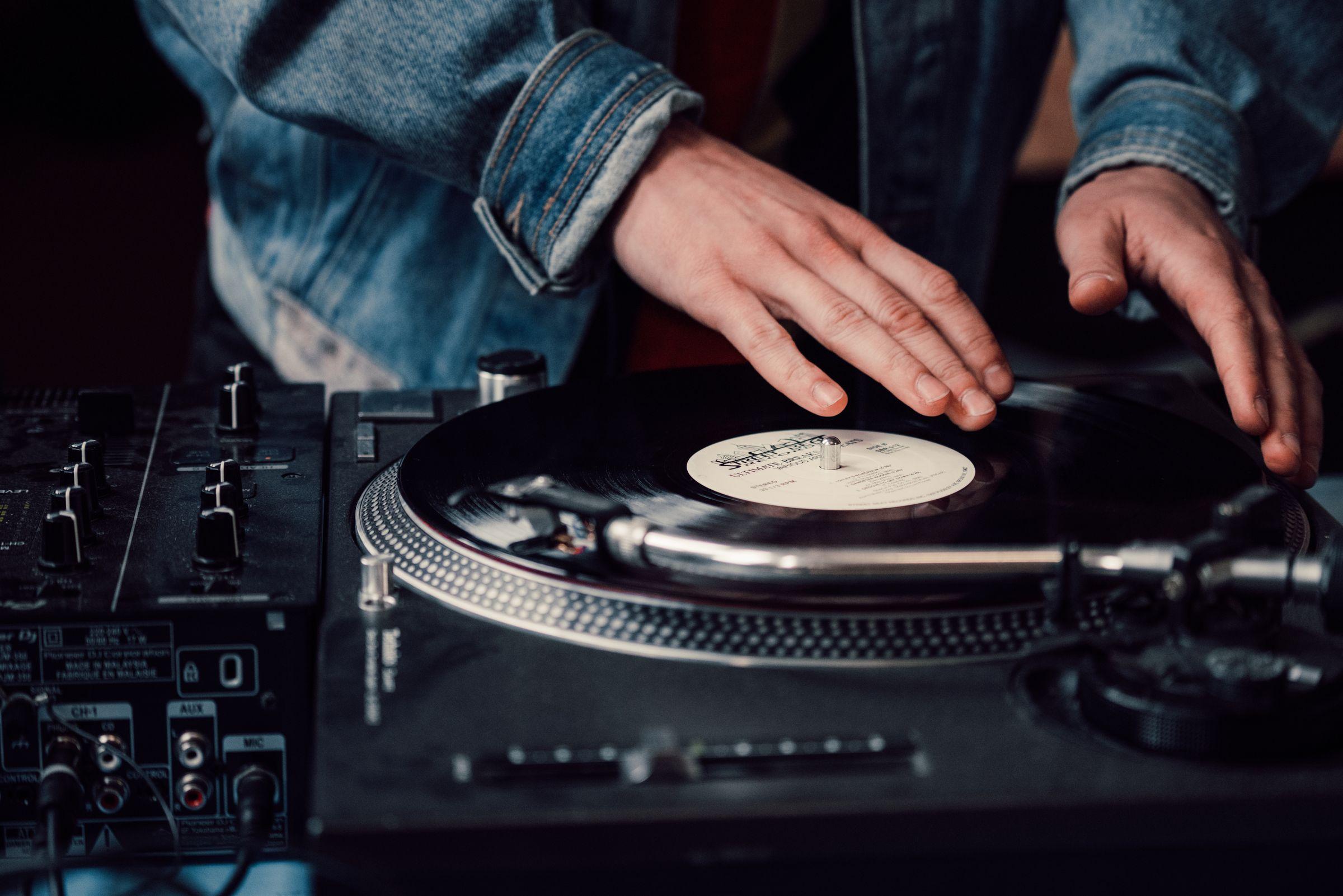
DJing is the art of playing recorded music for an audience, blending one track into the next so the music never stops, and choosing what to play based on the people in front of you.
A DJ (short for disc jockey) might play a club, a wedding, a radio show, a festival stage or a live stream. The tools have changed from radio studio turntables to vinyl, CDs, laptops and today's standalone systems, but the job hasn't: find great music, put it in the right order and keep people listening or dancing.
By John Stericker · Updated
01
What a DJ does
At its simplest, a DJ plays one song after another. What makes it DJing is everything around that: how the tracks are chosen, how one flows into the next, and how the music responds to the room.
In a typical mix, the DJ listens to the next track in headphones while the crowd hears the current one. They match its speed to the playing track (beatmatching), find the right moment to bring it in (usually at the start of a musical phrase), and blend the two using the mixer's faders and EQ. Done well, the listener barely notices the change, only that the energy keeps moving.
The bigger part of the job is selection. A DJ is a curator and a crowd reader: warming up an empty room, building to a peak, bringing it down, playing the song a wedding has waited all night for, or introducing people to music they have never heard. Technique gets the tracks together; taste and timing make the night.
02
A short history of DJing
DJing grew out of radio, travelled through dance halls and sound systems, and was reinvented in the clubs and block parties of the 1970s. Each new generation of equipment changed what DJs could do, but the core idea has stayed the same for nearly a century.
1930s
The radio disc jockey
Radio presenters start building shows around records instead of live bands. The columnist Walter Winchell is credited with coining "disc jockey" in 1935, describing announcers who rode the discs the way a jockey rides a horse.
1940s to 1950s
Dances, hops and sound systems
Records replace bands at dances because they are cheaper and the music is the exact version people know from the radio. In Jamaica, sound systems with huge speaker stacks become street-level institutions, and selectors compete for the crowd with exclusive records.
1960s
Mixing is born
Dance clubs in New York and Europe play records back to back to keep people dancing. DJs such as Francis Grasso start overlapping records and matching their tempos by ear, the beginnings of beatmatching.
1970s
Disco and the extended mix
Disco turns the DJ into the centre of the night. Private parties such as David Mancuso's Loft and clubs such as the Paradise Garage, where Larry Levan played, treat the sound system and the music as the main event. Remixers stretch songs into longer, more mixable 12-inch versions made for the dance floor.
1973
Hip hop and the break
At a party in the Bronx, DJ Kool Herc loops the instrumental breaks of funk records using two copies on two turntables, so dancers get the best part of the song for longer. Grandmaster Flash refines the technique and Grand Wizzard Theodore is credited with discovering the scratch. The turntable becomes an instrument.
1980s
House and techno
In Chicago, Frankie Knuckles at the Warehouse gives house music its name. In Detroit, a group of young producers builds techno. Both lean on affordable drum machines and synths, and the DJ and the producer start to become the same person.
Late 1980s to 1990s
Raves and superclubs
Acid house sparks a rave explosion in the UK and Europe. Outdoor parties, then purpose-built superclubs, and the island of Ibiza turn star DJs into headline acts. Turntablism grows into its own art form, with battle competitions judged on scratching and juggling.
1990s to 2000s
CDs and laptops
CD players built for DJs arrive, then players with large vinyl-style jog wheels. Digital vinyl systems let DJs control music files with special timecode records, and DJ software on a laptop puts a whole record collection in a backpack.
2010s
The festival era
Electronic dance music fills stadiums and festival main stages, and DJ controllers make it cheap to start. USB sticks replace CDs in the club booth, and live streams take DJ sets around the world.
2020s
Standalone, streaming and stems
All-in-one systems play straight from USB or streaming services with no laptop. Software can split a finished track into vocals, drums, bass and melody in real time. At the same time, vinyl keeps growing, and a new generation learns on phones, controllers and turntables alike.
03
Types of DJ
"DJ" covers a wide range of work. Most DJs do more than one of these, and the skills overlap, but each has its own craft.
Club DJ
Plays clubs and bars, usually for a set of one to three hours. The job is to read the room and build the energy across the night, often in a single genre or a few related ones. Residents play the same venue regularly; guests and touring DJs are booked for a night.
Mobile and event DJ
Brings the sound system to weddings, birthdays, corporate events and school formals. Plays across every era and genre, takes requests, runs the microphone and keeps the night on schedule. Often the busiest working DJs in any city.
Radio DJ
The original disc jockey. Presents and programmes music on air or online, talks between songs and builds a show around a sound. Many specialist dance music shows feature continuous mixes.
Turntablist and battle DJ
Treats the turntable and mixer as an instrument. Scratching, beat juggling and cutting are the main event, and competitions judge technique, creativity and routine.
Hip hop and open-format DJ
Moves quickly between genres and eras: hip hop, R&B, dancehall, pop, throwbacks. Short blends, cuts and crowd favourites, often in bars and parties where variety matters more than long mixes.
Producer-DJ
Makes their own tracks and remixes and plays them in their sets. Most well-known electronic DJs today are producers first, and their releases are what get them booked.
Selector
A term from reggae sound system culture for the person choosing the records, alongside an MC. Today it is also used for DJs known for digging out rare or unusual music rather than technical mixing.
Streaming and online DJ
Performs to a camera for an online audience. Since the late 2010s, and especially since 2020, live-streamed sets have become a way to build a following without a club.
04
How DJing grew in popularity
For most of the 20th century the DJ was background: the person on the radio or behind the decks at a dance. That changed in stages.
Disco made the DJ the reason people went out, and gave them records made specially for the dance floor. Hip hop put the DJ at the heart of a whole culture and turned the turntable into an instrument. House, techno and rave in the late 1980s and 1990s made DJs the headline act, with superclubs, compilation albums and DJs touring the world.
The 2010s took it further. Electronic dance music filled festival main stages and arenas, and the biggest DJs became household names. At the same time, the cost of starting fell sharply: a controller and free software made DJing a hobby anyone could try, and live streams and social media let new DJs find an audience from their bedroom.
Today DJing is one of the most popular ways to get into music. People DJ for a living, for weddings and events on the side, for their friends, or purely for the joy of mixing at home.
05
Music styles DJs play
DJs play every kind of music, but some styles were made for DJing: steady tempos, long intros and outros for mixing, and arrangements built in predictable phrases. These are some of the big ones, with typical tempos.
| Style | BPM | Sound |
|---|---|---|
| DiscoFour-on-the-floor kick, strings, horns and soulful vocals. The root of club DJing and still loved through edits and re-edits. | 110 to 125 | Four-on-the-floor kick, strings, horns and soulful vocals. The root of club DJing and still loved through edits and re-edits. |
| Hip hopBuilt from breaks and samples. DJing is part of its foundations, alongside MCing, breaking and graffiti. | 85 to 100 | Built from breaks and samples. DJing is part of its foundations, alongside MCing, breaking and graffiti. |
| HouseSteady four-on-the-floor grooves with soul, disco and gospel roots. Branches include deep, tech, Afro and progressive house. | 118 to 128 | Steady four-on-the-floor grooves with soul, disco and gospel roots. Branches include deep, tech, Afro and progressive house. |
| TechnoMachine-driven and hypnotic, built on drum machines and synths. Long, gradual mixes are part of the style. | 125 to 140+ | Machine-driven and hypnotic, built on drum machines and synths. Long, gradual mixes are part of the style. |
| Drum and bassFast breakbeats over heavy basslines, grown from UK jungle. Quick mixing and doubles are common. | 160 to 180 | Fast breakbeats over heavy basslines, grown from UK jungle. Quick mixing and doubles are common. |
| UK garageShuffled, swung beats with chopped vocals. Leads on to grime, dubstep and much of today's UK bass music. | 130 to 136 | Shuffled, swung beats with chopped vocals. Leads on to grime, dubstep and much of today's UK bass music. |
| TranceBig melodies, long builds and euphoric breakdowns. A main-stage sound of the 1990s and 2000s. | 130 to 140 | Big melodies, long builds and euphoric breakdowns. A main-stage sound of the 1990s and 2000s. |
| BreaksBroken, funk-inspired drum patterns instead of a straight kick. Big in Australia in the early 2000s. | 125 to 135 | Broken, funk-inspired drum patterns instead of a straight kick. Big in Australia in the early 2000s. |
| Dubstep and bassHalf-time rhythms and heavy sub bass. Influenced festival EDM in the 2010s. | 140 (half time) | Half-time rhythms and heavy sub bass. Influenced festival EDM in the 2010s. |
| EDM and big roomFestival-sized drops built for main stages. The sound that brought DJs to stadiums in the 2010s. | 126 to 130 | Festival-sized drops built for main stages. The sound that brought DJs to stadiums in the 2010s. |
| Amapiano and Afro houseSouth African sounds with log-drum basslines and rolling percussion, now played in clubs around the world. | 110 to 122 | South African sounds with log-drum basslines and rolling percussion, now played in clubs around the world. |
| Open formatA mix of everything: hits, throwbacks, hip hop, pop and dance. The everyday language of bars, weddings and parties. | Any | A mix of everything: hits, throwbacks, hip hop, pop and dance. The everyday language of bars, weddings and parties. |
Tempos are a guide; every genre has slower and faster corners, and plenty of great sets move between styles.
06
DJ equipment through the ages
Every generation of DJ gear has changed what DJs can do, and every generation is still in use somewhere. Here is how the setup evolved.
1930s to 1960s
Radio studio turntables, 78 and then 45 rpm records, valve amplifiers
Recorded music replaces live bands for broadcasts and dances.
1970s
Belt-drive and early direct-drive turntables, rotary mixers, big club sound systems, 12-inch singles
Two decks and a mixer become the DJ setup. The 12-inch single is made for DJs. Technics launches the SL-1200 in 1972.
1979 to 1990s
Technics SL-1200MK2 (1979), fader DJ mixers with crossfaders, drum machines such as the Roland TR-808 and TR-909
A quartz-locked direct-drive turntable with a pitch slider becomes the club standard for decades, and scratch mixers with light crossfaders follow.
1990s to 2000s
DJ CD players, then players with large jog wheels such as the Pioneer CDJ-1000 (2001), and standalone effects units such as Pioneer's EFX series and Korg's Kaoss Pad
DJs can play their own CD-R burns and unreleased tracks, with cue points and loops at the touch of a button. An effects unit patched into the mixer adds echoes, filters and loops on top.
2000s
Digital vinyl systems (timecode records), DJ software on laptops, the first DJ controllers
A laptop holds the whole collection. Timecode vinyl keeps the feel of records while playing files.
2010s
USB media players linked over a network, affordable controllers, library software such as rekordbox and Serato, remix stations such as the Pioneer RMX-1000
USB sticks replace CDs in the booth. A capable starter setup costs a few hundred dollars.
2020s
Standalone all-in-ones with touchscreens, Wi-Fi streaming, real-time stem separation, battery-powered systems
No laptop needed, music streamed on demand, and tracks split into parts live. Turntables and vinyl remain the choice of many DJs.
The main kinds of DJ setup today
- DJ controller: jog wheels, a mixer and pads in one unit, plugged into a laptop, tablet or phone running DJ software. The most common way to start.
- All-in-one (standalone) system: a controller with its own screens and computer built in. Plays from USB or streaming with no laptop.
- Media players and a mixer: the club booth standard. Two or more players reading USB sticks, plus a separate DJ mixer.
- Turntables and a mixer: vinyl records, or timecode records controlling software. The original setup and still a favourite.
Any of these can be extended with an effects unit: a separate box patched into the mixer for echoes, reverbs, filters, loops and samples. Pioneer's RMX-1000 remix station and Korg's Kaoss Pads are the best known. Built-in effects have made them less common, but many DJs still like the hands-on control, and they turn up second-hand regularly.
Want to feel the difference? Have a go on our virtual decks in your browser, or book time on vinyl, CD and controllers in the studio.
07
The core skills of DJing
Whatever the setup or the style, these are the skills every DJ builds.
- Choosing music
- The most important skill and the one you never stop working on. Great DJs are known for what they play: digging for records, knowing a collection inside out and picking the right track for the moment.
- Beatmatching
- Matching the tempo and lining up the beats of two tracks so they play together without the drums clashing. Sync buttons can do it for you, but learning by ear gives you control when things drift.
- Phrasing
- Dance music is built in blocks of 8, 16 and 32 bars. Starting a mix at the top of a phrase means changes land where the listener expects them, so the transition feels natural.
- EQ and gain
- Using the mixer's high, mid and low controls to blend two tracks cleanly, usually by swapping the bass from one to the other, and keeping levels out of the red.
- Reading the room
- Watching how people respond and adjusting: when to lift the energy, when to give the floor a breather, and when a request will help or hurt the night.
- Programming a set
- Planning the journey across a whole set: warm-up, build, peak and close, and understanding where your slot sits in the night.
- Harmonic mixing
- Mixing tracks in compatible musical keys so melodies and basslines blend instead of clashing. Most DJ software shows each track's key.
- Scratching and performance
- Moving a record (or a jog wheel) by hand to create rhythmic sounds, plus loops, hot cues and effects. Essential for turntablists, useful for everyone.
08
Where DJing is now
DJing in the 2020s is more open than it has ever been. You can learn on a phone app, a controller, a standalone system or a pair of turntables, and play music streamed on demand or from a carefully built collection.
The technology keeps moving. Standalone systems have made the laptop optional. Real-time stem separation lets DJs pull the vocal out of one track and lay it over another, live. Sync and beat analysis take care of the maths, so more of a DJ's attention can go on choosing music and reading the room.
At the same time, the classics are thriving. Vinyl sales have grown for years, turntables are still in booths everywhere, and many DJs choose records for their sound and the discipline of mixing by hand. Club booths have settled on networked media players, while mobile DJs rely on controllers and all-in-ones.
Australia has a long DJ culture of its own: radio, clubs and warehouse parties in every capital, outdoor bush doofs, huge dance festivals and a busy wedding and events circuit. In Newcastle and the Hunter, DJs play pubs, clubs, open decks nights, weddings and private events most nights of the week.
The best way to understand DJing is to try it. Book a lesson and you will be mixing two tracks within your first session.
09
DJ glossary
- BPM
- Beats per minute, the tempo of a track.
- Beatmatching
- Adjusting a track's speed so its beats line up with the track already playing.
- Cue
- A marked point in a track to start from, and listening to the next track in headphones before the crowd hears it.
- Crossfader
- The horizontal fader on a mixer that blends between the left and right channels.
- Channel fader
- The vertical volume control for each channel on a mixer.
- EQ
- Equaliser. The high, mid and low controls that shape each channel's sound.
- Jog wheel
- The large platter on a controller or player used to nudge, search and scratch.
- Pitch fader
- The slider that speeds a track up or slows it down.
- Phrase
- A block of bars, usually 8, 16 or 32, that a track is built from.
- Hot cue
- A saved point you can jump to instantly with a pad or button.
- Stems
- The separate parts of a track, such as vocals, drums, bass and melody.
- Effects unit
- A box patched into the mixer that adds echo, reverb, filters and samples to the music. Pioneer's RMX and EFX units and Korg's Kaoss Pads are well-known examples. Most mixers and controllers now have effects built in.
- Timecode vinyl
- Records with a control signal that let turntables play digital files.
- Set
- A DJ's performance, from the first track to the last.
- B2B
- Back to back: two DJs sharing the decks and taking turns.
10
Questions about DJing
What does a DJ actually do?
A DJ chooses and plays recorded music for an audience, blending one track into the next so the music never stops. Beyond the mixing, the real job is reading the crowd and picking the right music at the right time, whether that is a club, a wedding, a radio show or a live stream.
Is DJing hard to learn?
The basics are quick to pick up: most people can play two tracks and blend them in their first lesson, especially with sync. Mixing smoothly by ear, phrasing, EQ and reading a crowd take months of regular practice, and choosing music well is a lifelong skill.
What equipment do I need to start DJing?
A two-channel DJ controller, a laptop with free DJ software, a pair of headphones and some speakers is enough. Controllers start at a few hundred dollars. Later you might move to standalone systems, club-standard media players or turntables, depending on the kind of DJ you want to be.
How long does it take to learn to DJ?
With a few hours of practice a week, most people can play a confident, smooth hour-long set within a few months. Lessons shorten that a lot, because you learn good habits early instead of unlearning bad ones.
What is the difference between a DJ and a producer?
A producer makes music in a studio; a DJ plays music to an audience. Many DJs also produce, and many producers DJ, but they are different skills. You don't need to make music to be a great DJ.
Should I learn on vinyl, CDJs or a controller?
All three teach the same core skills. Controllers are the cheapest way to start. Club-standard media players are what you will find in most booths. Vinyl teaches you to beatmatch by ear and has a sound and feel many DJs love. Try them all before you buy.
Do DJs just press play?
Sync can line up the beats, but it doesn't choose the next track, decide when to bring it in, shape the blend with EQ or read the dance floor. Those choices are what separate a good DJ from a playlist.